The HWID Spoofer is built for modern PC games that rely on hardware-based enforcement rather than simple account bans. It works by virtualising key hardware identifiers commonly queried by game anti-cheat systems, allowing games to see a clean, isolated system profile during active play. This process happens entirely at runtime, without modifying BIOS, firmware, or physical components, so your real hardware remains untouched and fully recoverable. Designed with competitive gaming environments in mind, the spoofer avoids aggressive kernel hooks, unsafe drivers, and permanent system changes that often lead to crashes or detection. Instead, it prioritises session-level consistency, correct timing, and minimal system exposure to maintain stability while games are running. By preventing long-term hardware correlation between sessions, the HWID Spoofer helps reduce the risk of account linkage and hardware-based bans, allowing players to return to supported games on the same PC with a clean hardware profile.

HWID Spoofer – Breaking Hardware-Based Enforcement at the System Level Hardware-based enforcement has replaced account-based enforcement.
Modern anti-cheat and security frameworks no longer treat bans as isolated account events. Today, enforcement is driven by persistent hardware identification (HWID) and system-level fingerprinting models that survive reinstalls, new accounts, and even clean operating system images.
Once a system fingerprint is flagged, enforcement becomes automatic.
At that point, gameplay behaviour, account age, and legitimacy no longer matter.
The system itself is identified.
An HWID spoofer exists to address that shift.
Not through unsafe permanent modification, not through brute-force randomisation, and not through short-lived resets — but through controlled, lifecycle-aware hardware identity virtualisation designed for modern correlation-based detection architectures.
PC V3 HWID Spoofer is engineered to operate alongside modern, hardware-based and kernel-level anti-cheat systems that rely on system fingerprinting and long-term device correlation. The architecture focuses on consistency, correct execution timing, and non-persistent operation to ensure compatibility without introducing abnormal behaviour patterns.
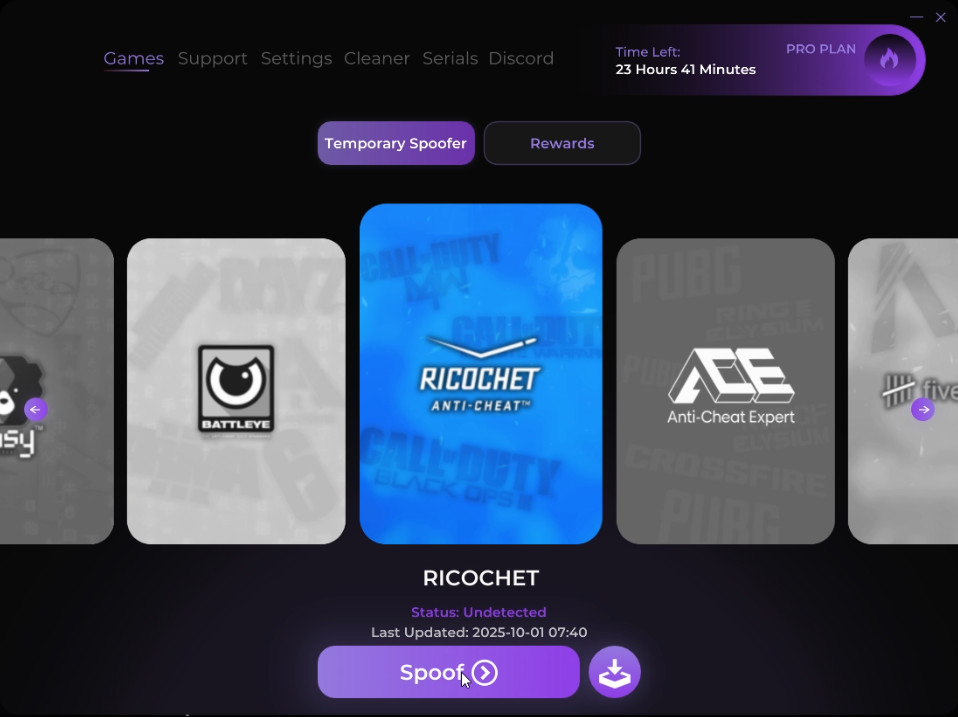
Compatibility includes widely deployed platforms such as Easy Anti-Cheat (EAC), BattlEye, RICOCHET Anti-Cheat, Anti-Cheat Expert (ACE), FiveGuard, and NetEase Games anti-cheat frameworks.
PC V3 supports Fortnite, including competitive and tournament environments, and includes a specialised cleaner to help address Fortnite-specific local traces when required. It is also ready for use across the Call of Duty series, supporting modern enforcement methods such as TPM-related checks used in newer titles.
Note: This product is not designed for use with Valorant.
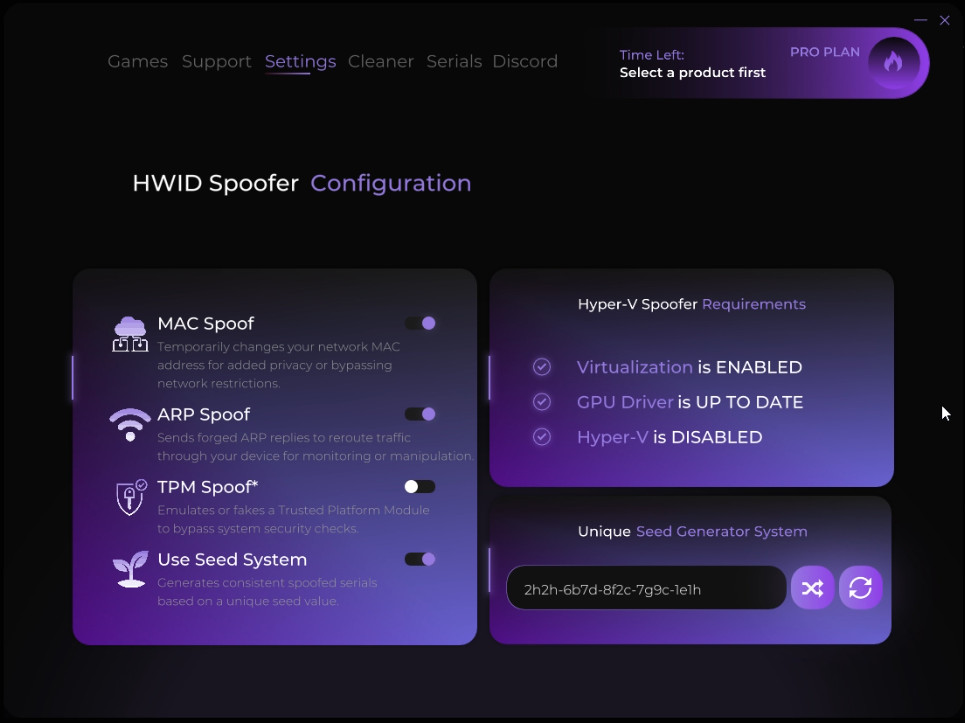
PC V3 HWID Spoofer is designed for broad hardware compatibility and operates without requiring firmware flashing, BIOS modification, or permanent system changes.
It supports all major motherboard platforms and both Intel and AMD processors, and is fully compatible with Windows 10 and Windows 11 environments. All spoofing operations are session-scoped, ensuring original hardware identifiers are restored on reboot or unload.
This approach preserves system stability while allowing controlled, temporary management of hardware identifiers during active sessions.

A modern system fingerprint is not a single value.
Anti-cheat frameworks construct composite hardware identities by aggregating multiple identifier sources across kernel mode, user mode, and cached operating system structures. These identifiers are queried repeatedly, correlated internally, and compared across sessions.
Common hardware correlation inputs include:
Once captured, this data is persisted and reused.
The purpose of an HWID spoofer is to interrupt that persistence.

Most HWID spoofers fail because they misunderstand the problem.
Randomising identifiers blindly creates entropy anomalies.
Permanent modification creates forensic residue.
One-time resets leave correlation intact.
This HWID spoofer uses a session-scoped virtualisation model.
Rather than altering physical components or firmware, it introduces a controlled abstraction layer that intercepts hardware identifier queries and returns internally consistent, non-persistent values during active sessions.
Within a session:
Across sessions:
This preserves system integrity while preventing long-term hardware fingerprint reuse.
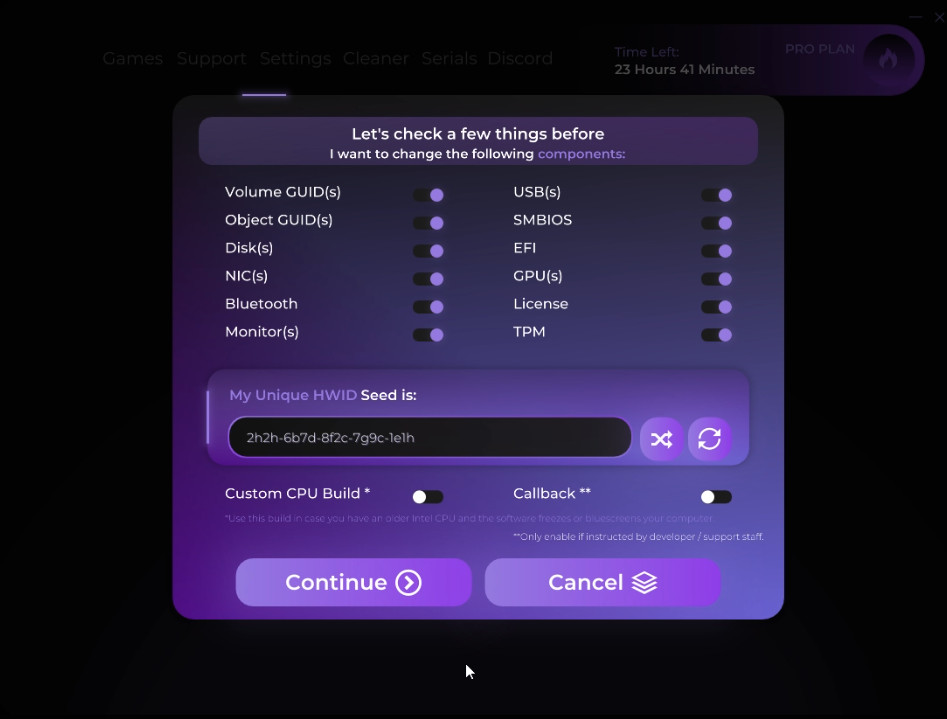
Anti-cheat systems operate in stages.
Hardware identification occurs:
HWID spoofers that operate outside the correct lifecycle window are detected quickly.
If spoofing occurs before anti-cheat initialisation, baseline values are cached.
If spoofing occurs too late, discrepancies are detected.
This HWID spoofer is built around lifecycle-aware execution, ensuring hardware identifier virtualisation is active during the exact phases where correlation is established — and remains consistent for the duration of the session.
Timing matters as much as the data itself.
Hardware identifiers are not queried through a single API.
They are accessed through layered call paths, including:
Attempting to hook every possible path increases detection surface and instability.
Instead, this HWID spoofer targets convergence points — locations where multiple call paths resolve to shared responses or cached data.
By virtualising identifiers at these convergence points, the system ensures:
Consistency beats coverage.
One of the most common enforcement triggers is cache incoherency.
Anti-cheat drivers aggressively cache hardware identifier data. If values drift mid-session — even subtly — correlation flags are raised.
This HWID spoofer enforces:
Each session presents a single, plausible system identity.
No drift.
No entropy spikes.
No mismatch.
Aggressive kernel manipulation is a liability.
Many public HWID spoofers fail because they:
This HWID spoofer follows a minimal exposure principle.
It avoids:
By reducing kernel footprint and limiting interaction to what is strictly required, detection surface is minimised while effectiveness is maintained.
Lower exposure equals higher longevity.
Permanent changes are detectable over time.
This HWID spoofer does not:
All hardware ID virtualisation is session-bound.
On unload or reboot:
The system always returns to a known clean baseline.
Most tools fail for predictable reasons:
Detection does not require identifying every spoofed value.
It only requires identifying inconsistency.
This HWID spoofer is engineered to eliminate inconsistency.
An HWID spoofer is not a one-click immunity switch.
Hardware identity isolation removes the most persistent enforcement vector, but it does not replace operational discipline.
Reused accounts, reckless behaviour, or misconfiguration can still result in enforcement.
The spoofer provides a clean hardware identity baseline.
What happens on top of that depends on how responsibly it is used.
This solution is designed for users who understand:
It prioritises:
The HWID Spoofer is designed to operate alongside major modern anti-cheat systems used in competitive and extraction-based PC games. It is compatible with widely deployed platforms including BattlEye, Easy Anti-Cheat (EAC), RICOCHET Anti-Cheat, Vanguard, EA AntiCheat, FACEIT Anti-Cheat, VAC and VAC Live, nProtect GameGuard, XIGNCODE3, Hyperion-based frameworks, NetEase Anti-Cheat, Tencent Anti-Cheat, and other kernel-level and hardware-correlated detection systems.
Rather than targeting individual games, the architecture focuses on how these anti-cheat systems identify and correlate hardware at the system level. By controlling hardware identifier presentation during active sessions, the spoofer aligns with enforcement models that rely on system fingerprinting, kernel drivers, behavioural validation, and long-term hardware correlation rather than simple account-based checks.
This approach allows the HWID Spoofer to remain effective across a wide range of games and anti-cheat environments without requiring game-specific modifications or unsafe system changes.
Modern enforcement systems evolve continuously.
What does not change is the need to correlate hardware identity across time.
Session-scoped, lifecycle-aware HWID virtualisation removes that continuity without damaging the underlying system.
That is why this model survives longer than permanent spoofing.
Control the lifecycle.
Control the data.
Break the correlation.


Bypass Device Bans, Reset Your Digital Fingerprint, and Play With Complete Freedom HWID bans are one of the...
Read ArticleBypass Hardware Bans – Reset Your PC Fingerprint – Play BF6 Safely & Undetected Battlefield 6 has one...
Read ArticleHave you ever heard of a HWID spoofer? It sounds like something out of a sci-fi movie, but...
Read ArticleHave you ever heard of a HWID spoofer? If you're an avid gamer or someone who frequently uses...
Read ArticleBy Tom Capper – Last Updated: June 1 2022 Intro Hacking in online games is as safe as...
Read ArticleBy Tom Capper – Last Updated: June 7, 2022 Intro Cheating in a video game entails the...
Read ArticleBy Tom Capper – Last Updated: June 7, 2022 If you’ve never hacked before, you may be...
Read ArticleBrowse our full archive

Deploy the HWID spoofer immediately after launch. No waiting periods, no extended setup, and no unnecessary steps before it becomes active.
Hardware identifiers are virtualised only for the active session, preventing long-term correlation without permanently altering your system.
Designed to operate quietly alongside modern anti-cheat frameworks without introducing abnormal behaviour, timing anomalies, or unstable hooks.
The spoofer activates during the exact phases when hardware identification is collected, ensuring identifiers remain consistent when it matters most.
All virtualised hardware values remain stable throughout the session, eliminating mid-session drift or cache incoherency.
No firmware flashing, BIOS modification, or permanent registry changes. On reboot or unload, the system returns to its original clean state.
Avoids aggressive kernel residency and excessive syscall interception, reducing detection surface while maintaining effectiveness.
Breaks long-term hardware fingerprint reuse by preventing identifier persistence across sessions rather than relying on unsafe randomisation.
Ensures cached hardware values remain aligned across kernel and user mode queries, preventing mismatch-based enforcement triggers.
Built to maintain normal system behaviour and performance without crashes, instability, or gameplay interference.
Engineered to function alongside modern hardware-based and kernel-level anti-cheat systems used across competitive and extraction-based titles.
Provides a clean hardware identity baseline while leaving behavioural discipline and account management fully in the user’s control.